
Refinancing
Most Western Australian homeowners refinance every 3–5 years, and for good reason—rates drift, your situation changes, and lenders compete hard for switchers. Andy’s been helping Mandurah families refinance since 2000, comparing 40+ lenders to find better rates, lower repayments, or access to equity when you need it.
Andy made it straightforward and simple and represented us in a way that put our best foot forward.

Google Review
For the entire process Andy was a wealth of knowledge and provided excellent support, guidance and timely information.

Google Review
Top bloke, great service and locked in a great deal for us. Walked us through each step and had everything finalised really quickly.

Google Review
Andy made our refinancing and purchase of a new home seamless and within our guidlines.

Google Review
Let's Chat
Complete the form below and Andy will be in touch to discuss your refinancing options.
We Query Over 30 Lenders to Find an Outcome That’s Right for You










Why Refinance Your Home Loan?
The three most common reasons Andy’s Mandurah clients refinance:
- Better rate. Your lender hasn’t dropped your rate to match what they’re advertising to new customers. You’re paying a loyalty tax—often 0.3%–0.8% above what you could get by switching.
- Access equity. Your home’s grown in value and you want to pull out $50k–$150k for renovations, an investment property deposit, or debt consolidation without selling.
- Simplify debt. You’ve accumulated credit cards, a car loan, and personal debts at 8%–15% interest. Rolling them into your home loan at 5.5%–6.5% cuts your total monthly outgoings and clears the mess in one loan.
Less common but still valid: switching from interest-only to principal-and-interest to start paying the loan down, moving from fixed to variable (or vice versa) when your fixed term ends, or removing an ex-partner from the title after separation.
How Much You Could Save
Here's what the numbers look like on real Mandurah refinances Andy's done in the past 12 months:
Save ~$1,740 per year
Refinancing from 6.4% to 5.8% saves around $145 per month, $1,740 annually. That’s real money back in your pocket, not hypothetical.
Save ~$2,400 per year
A typical refinance from 6.2% down to 5.7% saves around $200 per month—$2,400 per year, $12,000 over five years.
Save ~$3,360 per year
Switching from 6.5% to 5.9% saves around $280 per month. Over five years, that’s $16,800 in your pocket instead of the lender’s.
Save ~$5,400 per year
Refinancing from 6.8% to 6.0% saves around $450 per month. On larger mortgages, the saving can hit $5k–$8k annually.

Refinancing in Mandurah vs Perth Metro
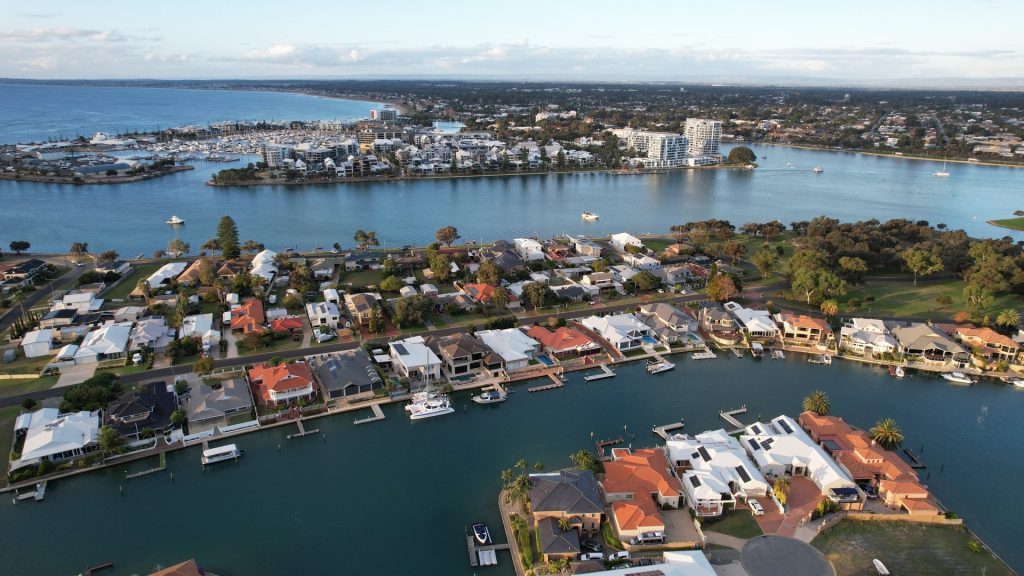
Mandurah properties—especially canal estates, older fibro beach shacks near the estuary, and new estates south of the bridge—are treated differently by lenders than inner-Perth suburbs. Some lenders won’t touch pre-1980 fibro or timber-frame homes in flood-prone pockets near the Peel Inlet without an engineer’s report. Others cap LVR at 80% in canal precincts (Halls Head, Dudley Park) because of perceived oversupply risk, even though those areas have held value well since 2020.
If you’re refinancing a Mandurah property, Andy knows which lenders will value it fairly and which will lowball or decline outright. A big-four bank’s automated valuation model often spits out a number 5%–10% under what a local valuer would certify, which can kill your refinance if you’re near the LVR threshold. Andy uses lenders whose panel valuers understand the Mandurah market—they know a 1990s brick-and-tile in Lakelands with a big backyard is worth more than the algo thinks.
Coastal salt corrosion is another Mandurah-specific factor. Homes within 1km of the ocean or estuary—especially anything with Colorbond or exposed steel frames—need proof of regular maintenance (photos, receipts for repaints every 5–7 years). Lenders ask for this on valuations over $600k. If you don’t have the paperwork, they either add a 0.1%–0.2% risk margin to your rate or cap your borrowing at 75% LVR instead of 80%. Andy flags this before you apply so you’re not surprised mid-process.
Why Work with a Broker to Refinance
Compare 40+ lenders in one pass
You can refinance by calling your bank or applying online direct to a new lender. But you won’t know if you’re leaving $50k on the table by not comparing, which lenders are competing hardest for switchers, or who to call when the valuation comes back low.
Local knowledge since 2000
Andy knows the local valuer panel, the suburbs where lenders consistently undervalue, and the quirks of financing older homes near the estuary or canal estates with shared jetties. That local knowledge is worth 0.1%–0.3% on your rate.
Equity calculations for cash-out refinancing
If your home’s gone up in value, you can usually borrow against that equity when you refinance—without selling. Andy works out how much is available, how the LVR will sit, and whether you’ll need lenders mortgage insurance before you apply.
Self-employed and non-standard lending
Self-employed Mandurah residents often assume they can’t refinance because their tax returns show low net profit. Andy knows which lenders accept BAS statements, bank statements showing cash flow, or accountant’s letters—getting you approved where the big four would decline.
You deal with Andy directly
No franchise juniors. Andy lodges the application, chases the valuation, answers when the lender’s querying something at 10 p.m., and sits with you at settlement if something needs explaining. His mobile is on every document.
Refinancing Questions Mandurah Homeowners Ask
Most Mandurah homeowners refinance when their fixed rate is ending in the next 3–6 months and the revert rate is 1%+ higher than market, when they haven’t reviewed their loan in 2+ years and suspect they’re overpaying, when they need to access $30k–$150k equity for something specific (reno, investment deposit, debt clear-out), when their financial situation has improved and they now qualify for better products, or when interest rates have dropped 0.5%+ since they last locked in.
The wrong time to refinance: when you’re about to sell within 12 months (the upfront costs won’t be recouped), when your loan balance is under $150k (the dollar saving is small and might not cover the exit/entry fees), or when your credit has deteriorated and you’d be offered a worse rate than you currently have.
The refinance itself has upfront costs—discharge fee from your old lender ($150–$400), application fee with the new lender ($0–$600, often waived), valuation ($200–$400), and sometimes legal fees if you’re changing ownership structure ($300–$800). Total cost to switch is usually $500–$1,500. If you’re saving $200+ per month, you’re ahead within 3–8 months and then it’s pure gain.
Yes. If your home’s gone up in value, you can usually borrow against that equity when you refinance—without selling. Say you bought in Mandurah for $450k five years ago with a $400k loan. You’ve paid it down to $370k and the property’s now worth $550k. Your usable equity is roughly 80% of $550k ($440k) minus your current loan ($370k) = $70k. You can refinance to a $440k loan, pay out the old $370k, and pocket $70k cash for renovations, an investment property deposit, or clearing high-interest debts.
Lenders assess your ability to service the higher loan. If your income supports the new repayments (usually $300–$500/month more on a $70k equity drawdown), they approve it.
Yes. Some lenders accept alternative docs: BAS statements, bank statements showing cash flow, accountant’s letters, ABN tenure. If you’ve been in business 2+ years and your bank statements show consistent deposits of $8k–$15k per month, several lenders will approve a refinance even when your tax return says you earned $45k.
Andy knows which lenders take BAS-only applications, which want 2 years of full financials, and which will go off bank statements alone if your credit is clean. The rate is usually 0.2%–0.5% higher than standard full-doc loans, but you get approved where the big four would decline you.
If you’ve got $15k on a credit card at 14%, $25k on a car loan at 8%, and $10k in personal debt at 12%, you’re paying around $650/month in interest alone—$7,800 per year. Roll that $50k into your home loan at 6% and the interest drops to $250/month—$3,000 per year. You’ve just saved $4,800 per year by consolidating.
The catch: you’re spreading a 3-year car loan and a 5-year personal loan over 25–30 years. If you only make minimum repayments, you end up paying more interest over the life of the loan. Andy’s approach: refinance to consolidate, lock in the lower rate, then keep paying the same total monthly amount you were paying before. You’ll clear the consolidated portion in 4–6 years instead of 30, and you’ve still saved thousands in high-interest charges.
Most Mandurah refinances land on variable rates because they’re 0.2%–0.5% lower than fixed right now (mid-2026) and you keep the flexibility to make extra repayments or redraw without penalty. If you’re risk-averse and want locked repayments for 1–3 years, fixed is still an option—but you pay a premium for that certainty, and if rates drop further you’re stuck at the higher rate until the fixed term ends (or you pay break costs, which can be $3k–$8k on a $500k loan).
Andy’s default recommendation for most Mandurah refinances: variable with an offset account. You get the lowest rate*, the ability to park your savings in the offset to reduce interest, and full flexibility to pay extra or redraw if something comes up.
From first call to settlement: 3–6 weeks, sometimes faster if your situation is straightforward and the valuation comes back quickly. Week 1: Andy reviews your current loan, runs serviceability across 6–8 lenders, picks the best fit, gathers your docs. Week 2: Application submitted, lender orders valuation, credit check done. Week 3: Valuation completed, conditional approval issued. Week 4–5: Final conditions cleared, loan docs signed, settlement date booked. Week 6: Settlement happens, new lender pays out old lender.
Most of the waiting is the lender’s internal process—you’re not doing much after week 2. Andy handles the back-and-forth with the lender, chases the valuer if they’re slow, and keeps you updated via text or email every few days.
Refinance applications get declined for three main reasons: credit issues (missed payments, defaults, too many credit enquiries in the past 6 months), serviceability (your income doesn’t support the new loan amount), or property issues (valuation too low, non-standard construction, lender doesn’t like the suburb).
If you get declined, it’s not the end. Andy has 40+ lenders on panel—if NAB says no, Bankwest might say yes. If the big four all decline because you’re self-employed with messy tax returns, there are specialist lenders who’ll approve you at a rate 0.5%–1% higher but get you across the line. You refinance with them now, clean up your financials over 12–24 months, then refinance again to a mainstream lender at a lower rate.
You can refinance by calling your bank or applying online direct to a new lender. You’ll probably get approved if your situation is clean. But you won’t know if you’re leaving $50k on the table by not comparing, you won’t know which lenders are currently competing hardest for switchers (and therefore offering better rates or cashback), and you won’t have anyone to call when the valuation comes back low or the lender asks for three more documents you’ve never heard of.
Andy compares 40+ lenders in one pass. He knows which ones have appetite for Mandurah properties, which ones will approve self-employed on BAS statements, which ones waive application fees for refinances over $400k, and which ones have the lowest break costs if you need to get out of a fixed loan.
Nothing upfront. Andy gets paid by the lender when your loan settles—a commission of around 0.6%–0.7% of the loan amount, paid once, then a small trailing commission (0.15%–0.2% per year) as long as you keep the loan. You don’t pay that—it’s baked into the lender’s cost of doing business.
The rate you get through a broker is the same rate (or better, because brokers often have access to special broker-only rates) than going direct. The lender isn’t charging you more to cover the broker’s commission—they’re just splitting their customer acquisition cost differently.


Experience you can't shortcut
Helping Western Australian homeowners refinance since before online applications existed
One call, he does the research—you get the best rate* you qualify for
From first call to new lower rate—Andy handles the back-and-forth so you don't have to

Reviewed by
Credit Representative & Mortgage Broker
The information on this page has been reviewed for accuracy by Andy Iriks, a Credit Representative & Mortgage Broker at Wanna Finance. It is general information only.